

Super Bowl LX
Today, the Seattle Seahawks face off against the New England Patriots. At the end of the game, the team with the higher score will be declared this year’s unambiguous champions and fêted with golden rings.
But another game is afoot.
This game can’t be won in inches, and it requires a style of play wildly adept at moving goalposts. It happens in the interlude of the main event because, in the words of Nas, “…the real rap comes at halftime.”
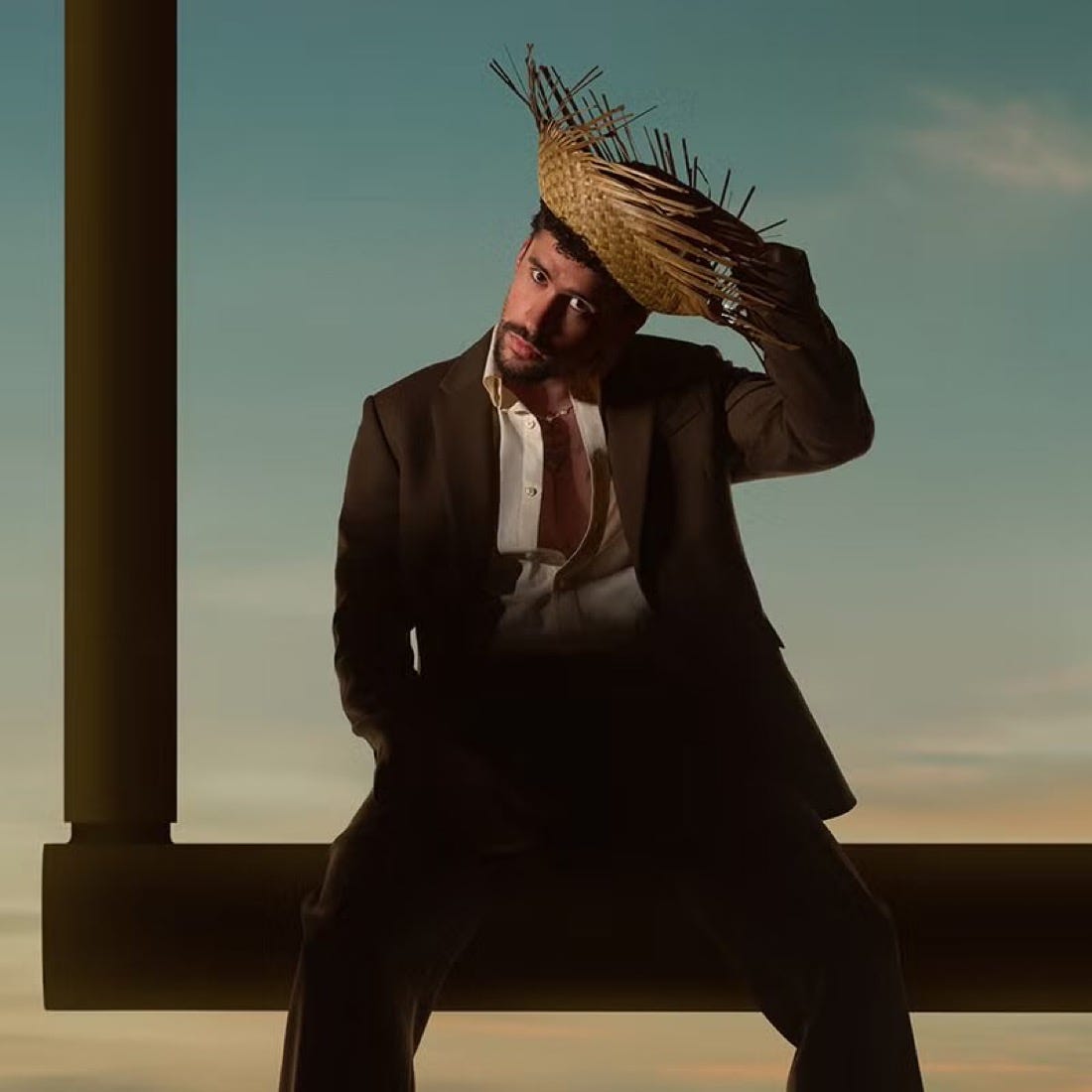
This year’s halftime show features Boricua sensation Bad Bunny, the "King of Latin Trap.” In the hours and days following his performance, we’ll flood comments sections to weigh in: Was it good? Will the revolution be televised? Was it legible—and to whom? What does it all mean?
Culture-warring is an American pastime. It is so regularized that it has genre conventions, ritual features, and pre-boarded controversies waiting to anchor the felt grievances and real conditions of an endlessly recurring question: who are the we?
We’ll debate multiculturalism and monolingualism. Someone will remind us that English only became the official language of the nation last March, while others insist that we have always been proudly pluralistic polyglots. Fandoms and cultural analysts alike will read the performance as a text, parsing the layers of danceability and political significance. We’ll talk about territorial ambitions, sovereignty, and belonging. Haters will dismiss the whole thing as incomprehensible, a nothing-burger, a sham. Others will point to ratings and views, as if the attention economy can adjudicate, once and for all, which side of the cultural war objectively won.
A few earnest gridiron enthusiasts will scratch their heads and ask, “Aren’t football games supposed to be about football?”
Someone else will shrug and remark, “I just watch for the commercials.”
Deep Play
Games aren’t always about what they’re about.
Anthropologist Clifford Geertz wrote about this freighting of games with social and cosmic significance in The Interpretation of Cultures (1973). In a bit of disciplinary arbitrage, he borrows the term deep play from Jeremy Bentham’s Theory of Legislation. “By it,” Geertz writes, “[Bentham] means play in which stakes are so high that it is, from his utilitarian standpoint, irrational for men to engage in it at all.”
Bentham was building a case from first principles against letting people get in over their head. (In the age of sports betting scandals, there is plenty to say about the hazards of side action). Geertz, however, takes the cultural turn in observing that, ethical questions aside, deep play persists.
For Geertz, Balinese cockfighting wasn’t merely a typical, if illegal and brutal, pastime. True, these poor, beautiful birds were condemned to short, nasty, and brutish lives of violent contests to shallow ends—and where’s the utility in that? But the deepest matches were affaires d’honneurs, “dramatization[s] of status concerns” between rivaling patrilines that structured social orders. Onlookers, bettors, and bird-keepers were interpreting the stakes and outcomes as contests over what is really Real.
The fight is culture, staged.
Deep play is a concept that gives us permision to acknowledge that things really do stand in for things, that the rituals of reading, and fighting over the meaning of that reading, are themselves forms of belonging within a shared social frame. Cultural fluency is the ability to recognize when the game is deep.
But what happens when the game speaks back?
Serious Games
In 2016, during the NFL preseason, San Francisco 49ers quarterback Colin Kaepernick sat during the national anthem. A silent one-person protest against racial injustice and police brutality, it disrupted the ritual conventions of the game as if to ask: “Seriously, what are we playing at?”
In that gesture, the connections between sport, nationalism, culture industries, and politics flashed into visibility. Look around! Wake up! What must we not notice in order to keep believing that this is just a game?
What happens when the man in the arena reframes the arena?
Kaepernick action can be read within a history of athletic protest. Literary scholar Kevin Quashie has written extensively this aesthetic language in The Sovereignty of Quiet: Beyond Resistance in Black Culture. Public resistance to the frame comes forth as an assertion of interiority. The player, the character, the performer suddenly insists that the deepest play and the biggest stakes are a recognition of humanity from within.
Otherwise, what is any of this for?
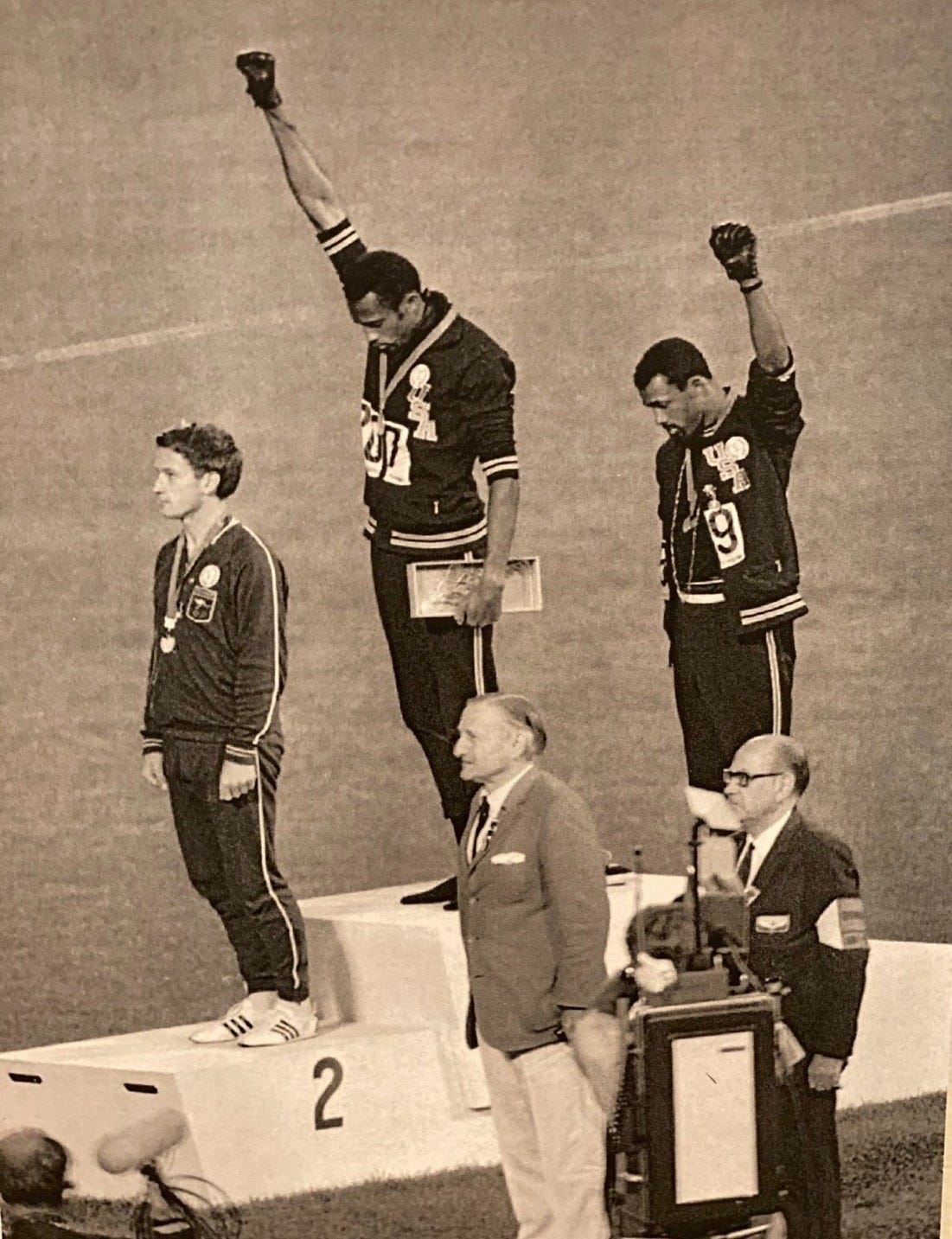
The “take a knee” movement spread. The NFL became a site of open cultural contestation. Kaepernick rose to the level of cultural icon. Resistance at the football game signified well beyond the sphere of sports, ultimately penetrating the political arena.
These were the early years of the first Trump presidency. The “Make America Great Again” movement, with its ubiquitous merch, was colliding with public cultures all over. Critics blamed Kaepernick for politicizing football. It’s probably more accurate to say that he was doing culture, and culture is deep play.
Ultimately, the rules of the game themselves became contested terrain. Protests were disallowed in an effort to close the frame (but end zone dances were finally allowed), to restore the illusion that nothing deep was at play. Kaepernick’s football career was over.
But what about that halftime show?
Cultural Interludes
The frame of the game already admits that other games are happening.
The halftime show is what I’ll call a cultural interlude: a sanctioned pause that openly confesses that the contest exceeds the frame. This is an intermission as theater, an aperture at the center of the sport that openly celebrates that football isn’t just about football. The arena becomes a stage. The interlude is a parallel sphere of social action where expresivity, aesthetics, and performativity are not distractions—they are the point. Here, we are invited to interpret.
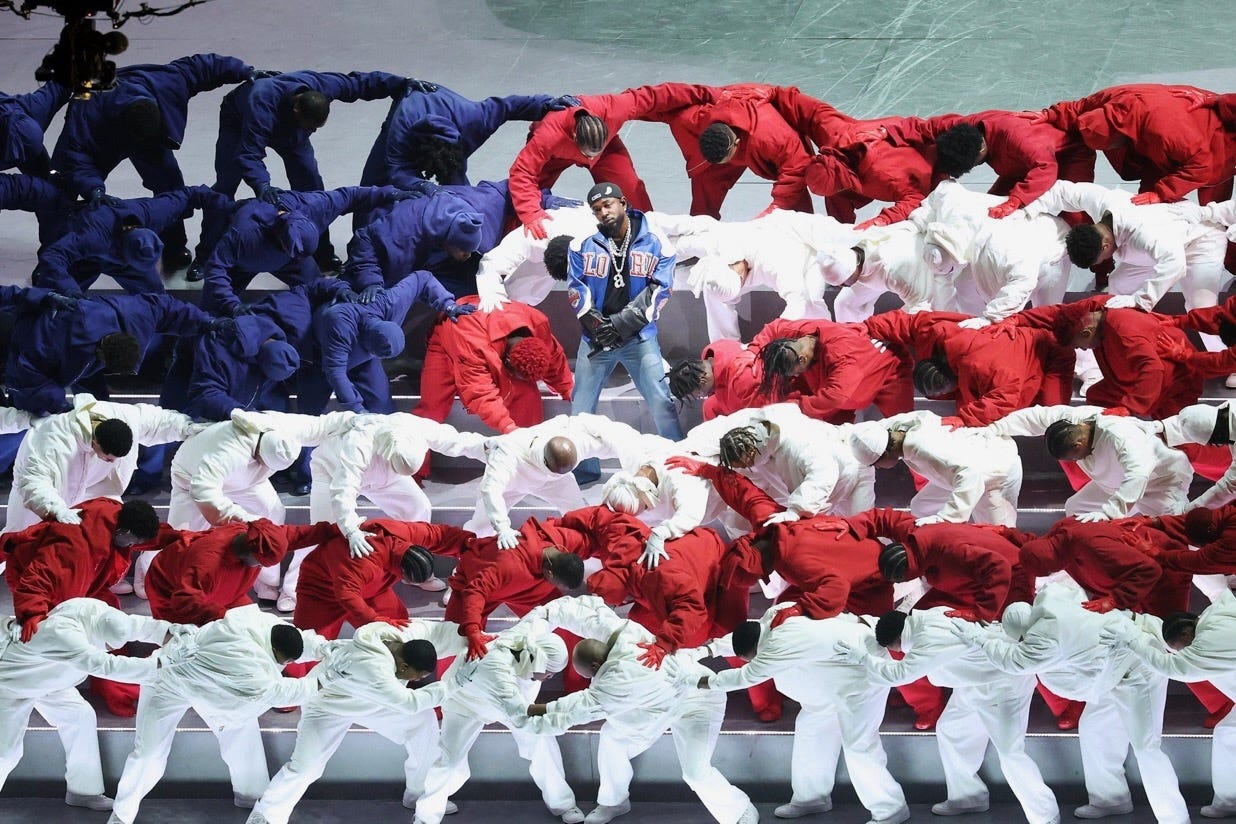
Last year’s halftime show put the cultural interlude to exquisite use. Kendrick Lamar, the first solo rapper to headline, delivered a minimalist spectacle in red, white, and blue structured like a three-part dialogue. Fresh off a summer of epic beefing with Canadian rapper Drake, the Grammy and Pullitzer-Prize winning artist was poised to summit this stage to deliver the ultimate American diss track. The inimitable Samuel L. Jackson played the role of Uncle Sam; Grammy-winner SZA gave a lyrical interlude within the show; Serena Williams — tennis legend, first Black woman with a stake in an NFL team, wife of tech billionaire/Reddit founder Alexis Ohanian — crip walked into the frame. The text was so layered that it fueled weeks of discourse about color, form, poetics, and implication. With 133.5 million viewers, it surpassed Michael Jackson’s record to become the most-watched halftime show in history.
Kendrick Lamar is an American Great. He is the Bard you can dance to.
The game of cultural interlude intensifies as the boundaries between sport, entertainment, and politics blur into a single spectacle. Parlays and side games are everywhere.
Last year, Taylor Swift was in the stands, seated on the Kansas side. The Pennsylvania-born mega-ultra-popstar chose her man in the arena, Travis Kelce (a tight end on last year’s field), over her home state. The heart wants what the heart wants, but the camera wants what the camera wants even more. In the year since, she’s released an album, gotten engaged, and the smart money says her future halftime show is inevitable.
This is deep play with a love story.
It was also the first Super Bowl attended by a sitting U.S. President. A small detail, except it isn’t. The game is deep in the age of culture warring. Trump had already marked his return to office with a pilgrimage to Madison Square Garden for a UFC fight, flanked by Joe Rogan, Dana White, Tulsi Gabbard, Robert F. Kennedy Jr, Vivek Ramaswamy, and Elon Musk. The entourage of spectacle purveyors and would-be power brokers made it painfully clear that we would be dealing in ambiguities between the mediated and the real for the remainder of his time in office. A man who rose to the highest office by way of reality television, professional wrestling, real estate, and beauty pageants knows exactly how arenas work.
There are layers to this shit.
Moving Goalposts: American Performing Arts
In American life, the Super Bowl is not just a sporting event. It is a ceremonial gathering where kin and friends assemble to rehearse belonging through team allegiances and shared attention. It means something.
This morning, I woke to feeds filled with clips from the Winter Olympics: Vice President Vance being booed in the international arena, U.S. athletes publicly distancing themselves from immigration crackdowns at home, commentators debating what representatives of a democratic nation owe the public when the whole world is watching.
The arenas are talking back.
Last year, in the wake of the Super Bowl, President Trump installed himself as head of the Kennedy Performing Arts Center. To some, it seemed peripheral. What’s the big deal? What do the arts have to do with politics anyway? But then came the board firings, the resignations, the artists pulling out of contracts, unwilling to perform under a name stamped onto every wall.
Last month, the Center closed for “renovations.”
The President will not attend Super Bowl LX. The cultural interlude is a dangerous place for a sovereign because it invites interpretation. Instead, MAGA media will circulate an alternative halftime show featuring Kid Rock, Brantley Gilbert, Lee Brice, and Gabby Barnett. When you don’t like the message, you don’t give up on arenas, you build another arena. When you can’t control the reading, you try to control the stage. You attempt to make a world where the game can be just a game again. But the interlude remains.
Welcome to the show.
So good!