In 1933, Richard Hollingshead of Camden, New Jersey, received a patent for his outdoor theater system. While not the first experiment with outdoor projections, his design introduced crucial architectural refinements: a semi-circular arrangement of inclined parking spots engineered to guarantee that everyone could enjoy the view—a democracy of sightlines.
The form caught. As many as fifteen drive-in theaters were in operation by the end of World War II. But in the postwar years, their popularity exploded. America’s romance with automobility was in full swing, and the passion for public cinema was transforming as neo-suburbanites domesticated leisure via television-watching in the single-family home.
Windshield cinema at the roadside theater was a kind of stopgap, an intermezzo between mass audiences packed into urban theaters and the new privated viewing of public culture alone at home. I have always loved interbetween forms. They are the lungfish of organizational evolution, awkward pioneers stepping boldly across the mud between epochs. Their very success ensures their disappearance. But here, at this threshold where public and private life are literally engineered into asphalt on an angle, we can pause long enough to watch a new social animal breathe the dynamics of change.
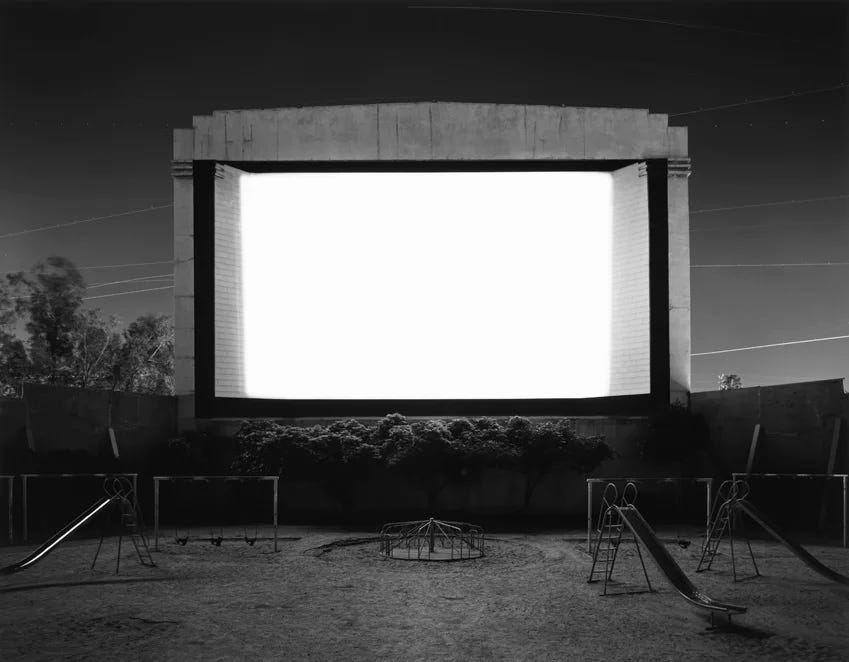
The photograph above was taken by Hiroshi Sugimoto. Sugimoto is renown for pointing his camera at movie screens and leaving the shutter open for the entire duration of a film. His works are a media philosophy in a thousand words: or, pictures. In each, the content dissolves into a white square of overexposure, a small artificial sun floating in the darkness.
A reversal of the mirro-facing-mirror mise-en-abyme, there is no infinite regress, no vertiginous casting the viewer into the recursive depths of frames within frames. Instead, the viewer meets conditions. Whatever the content was, it’s washed away. All that is left is architecture, darkness, and light. Call it the camera’s revenge on narrative.
Every Sugimoto photograph is different, yet every luminous rectangle looks the same. The difference that makes a difference is the theater itself, the very space that disappears during the show. Elsewhere, I have written about this darkness:
…No two darknesses are the same. Every interior has a distinctive shape, texture, and form.
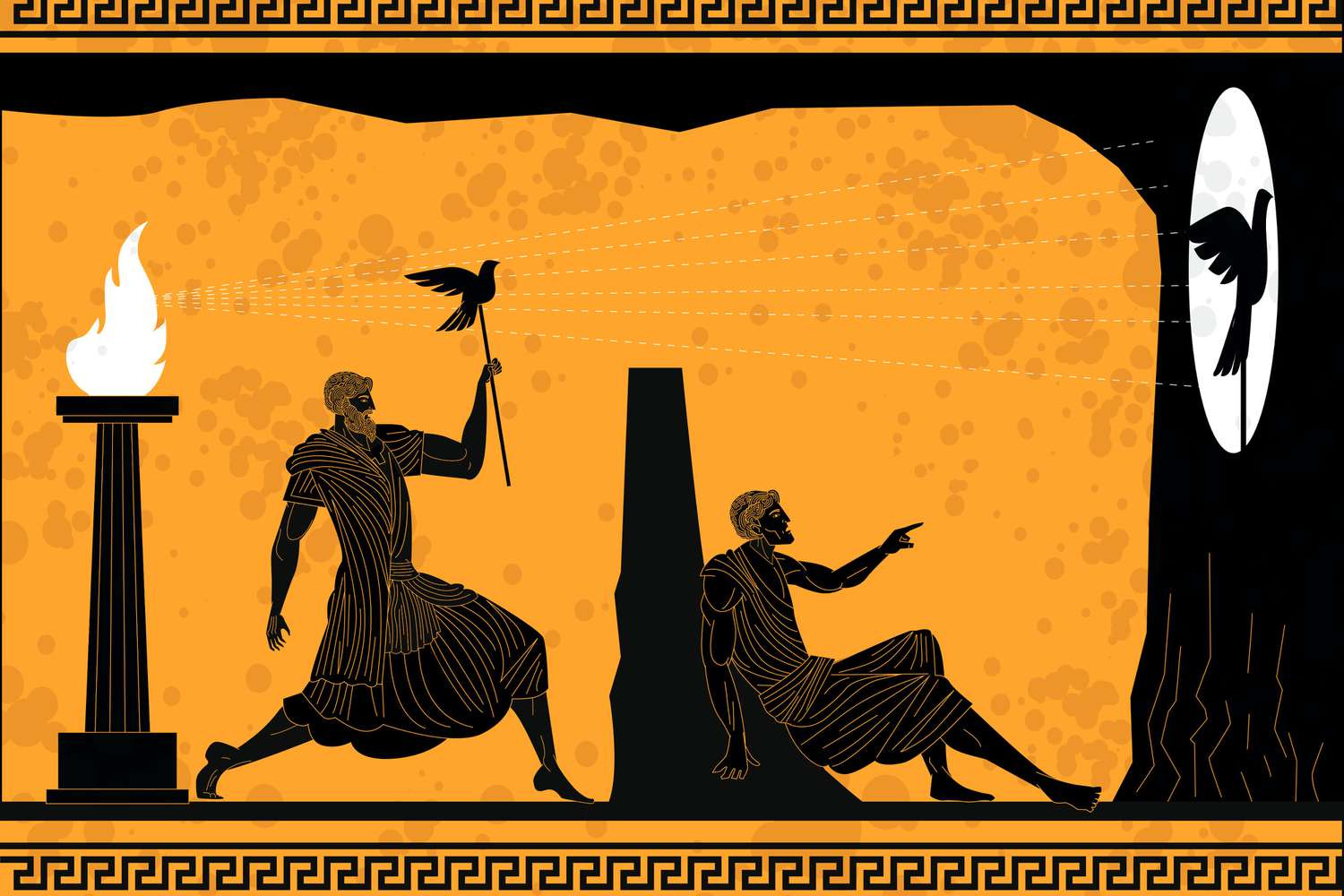
Darkness is first encountered in childhood but the encounter repeats throughout one’s life. Plato tells us this darkness is allegorical. Metaphysically, we are living in a cave. To seek truth and understanding one must turn towards the light. Otherwise, all one will ever see are images of shadows of divine things. There are limits to identifying with projections on the walls…
Darkness is a metaphysical fort/da game, a play with intersubjectivity that persists until we die. In darkness we open and close ourselves to connection. We do our best to get our fears and desires in hand. In darkness psychic life is speculation – what was that sound? Where are you? Are you still here? Barthes continues, “the significance of darkness in the cinema...is not only the very essence of reverie…it is also the color of a very diffuse eroticism.”[15] Darkness is a libidinal economy…
Here, I turn to see the American collectivity.
In the foreground, brightly is, is a playground.
Because of course, the drive-in was many things, including a solution to the demographic shock of the Baby Boom. It allowed families to go out while staying in. Vehicular enclaves transported domestic life into public space. Whatever was playing on the screen, children were playing below it.
Drive-ins doubled as all kinds of thing: playgrounds, swap meets, picnic grounds, flea markets, impromptu town squares, churches, etc. Economically, this makes sense. The core business offering requires acres of infrastructure sitting idle until sunset. Socially, it was a zone of experimentation, where the intertidal alchemy allowed different publics and many privates to glimpse another possible suburbanity, one marked by heterogeneity and mixture in society.
These where the Jim Crow years. Indoor theaters across the South enforced racial segregation, relegating Black audiences to balconies, back rows, or late-night “midnight rambles.” Drive-ins had a more uneven history. Restrictions existed, but the automobile introduced a layer of abstraction. Inside the car, out in the dark, identities blurred. The car gave a little social mask and a touch of portable cave.
Moral reformers worried about the drive-in. Derided as a “passion pit,” the whole arrangement allowed too much privacy in public and too much darkness without supervision. In the dark, social relations improvise. Indeed, as mainstream popularity waned, some drive-ins embraced the contradiction and bifucated their screens: family films on one side, X-rated on the other, double-backed double-features in virtue and vice. I believe one such drive-in still operates—somewhere in Texas, if I recall.
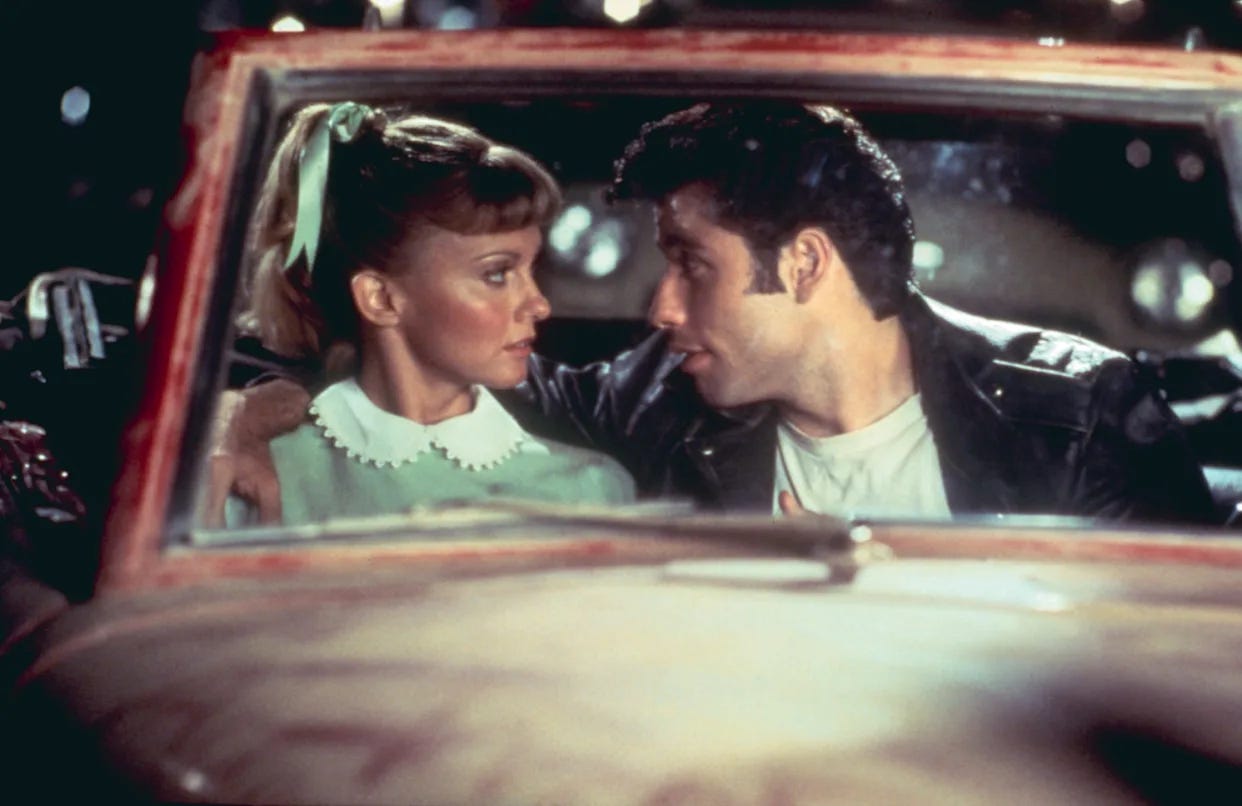
These chemistries collective life in action. Seedlings of interpersonal freedom to mingle, to provision alliances, to flirt with difference were sprouting up all over under cover of night—
—which brings me to my gripe with Plato’s cave.
Cinema is a game of shadows projected on walls, the heir to magic lanterns and other light-in-darkness technologies. Cinephiles sink into that darkness willingly, suspending disbelief so the interior self can become absorbed with an unfolding worldview. The philosopher’s task, in Plato’s telling, is to turn away, exit the cave, and face the sun—to identify the source rather than the spectacle. The critical cultural theorist is supposed to notice the means of production, the projection from the back, and shout “Aha! I cannot be fooled by my desire!”
But Sugimoto’s images sugges that the shadows and the light are not the most important things after all. Look at the room. Look at the seating. Look at the arrangement of bodies in spaces! The medium is only half the message; the social architecture is the rest.
Plato’s allegory depends on individuation. The prisoners are chained up separately, positioned in place. The one liberated hero who returns with an unbearable truth is doomed to rejection. They will be a scapegoat. The allegory is ultimately one of solitary enlightenment and collective ignorance—a foreshadowing of the death of Socrates.
But where are the ensembles, the negotiations, the sideways glances, whispered commentary, shared snacks, tangled limbs, bored children, and coupling making love or breaking up in backseats? Where are the people moving about, trying things out, experimenting in pairs and ensembles and enclaves? Where is the furniture of the social? Where there is no play with collectivity—those middle strategies humans actually use to live together—there is no social or historical truth at all.