Just The Chip
“The overarching question of comedies of remarriage is precisely the question of what constitutes a union.” - Stanley Cavell


I have no special insight into Jensen Huang’s marriage or the investigations surrounding his departure. My attention is soldered fast to the circuit between marriage, a public corporation, and the state, wondering: what constitutes a union?
A Spy in the House of Love?
On November 8, NVIDIA employees received an email that began with an apology:
“I owe my family and all of you an apology. I was unfaithful to my wife. My actions hurt her and our children. There is no excuse for what I did. I am deeply sorry.”
The letter continued with Huang’s open admission of his failure to be loyal to his family and honest with his colleagues. In accepting sole responsibility for damaging what they had built, he committed to doing the work to earn back their trust and confidence. It also affirmed Huang’s cooperation with an investigation into national security concerns and a declaration of pride in being American.
The situation escalated quickly. Reports of an affair became rumors about foreign intelligence operations, the transmission of restricted chips across national borders, and the complicity of the US President and Secretary of Commerce in knowingly suppressing this information for personal gain. Subsequent reporting brought an affair with a direct report to light. On November 12, Huang resigned.
“She can hardly hold back her tears because she sees nothing tearful.” — Ovid, Metamorphoses, translated by A.S. Kline
Jensen is not the first of the Billionaire Boys whose peccadillos have occasioned significant rearrangements of wealth. The Bezos split produced a $38 billion settlement. The Gates divorce divided a $130 billion fortune. If the Huangs part ways, it could be the largest divorce settlement in history, moving more wealth than the annual GDP of Luxembourg, Jordan, Bolivia, or Bahrain.
This spectacular scale of marital property enters public view amid six weeks of a falling NVIDIA stock price, blue-wave midterm election results, and growing international tensions over chip manufacture. The scandal offers a morality play for a multiplicity of publics already aggrieved by oligarchs, corruption, wealth inequality, inflation, and AI. Here is a full stack of grievances through which to seek justice, comeuppance, reconciliation, repudiation, or some reassuring correspondence between merit and fortune. Envy, or Invidia in Latin, “poisons homes, cities, and peoples with her breath” (Ovid).
And yet—none of us can indulge quite so freely. NVIDIA’s place in investment portfolios and the infrastructure of the AI boom means people who have never met the Huangs have vested interests in what comes next. NVIDIA accounted for approximately 15.5% of the S&P 500’s gains in 2025. Retirement accounts, jobs, industrial plans, and political ambitions bind us rather uncomfortably to the intimate arrangements of other people’s households.
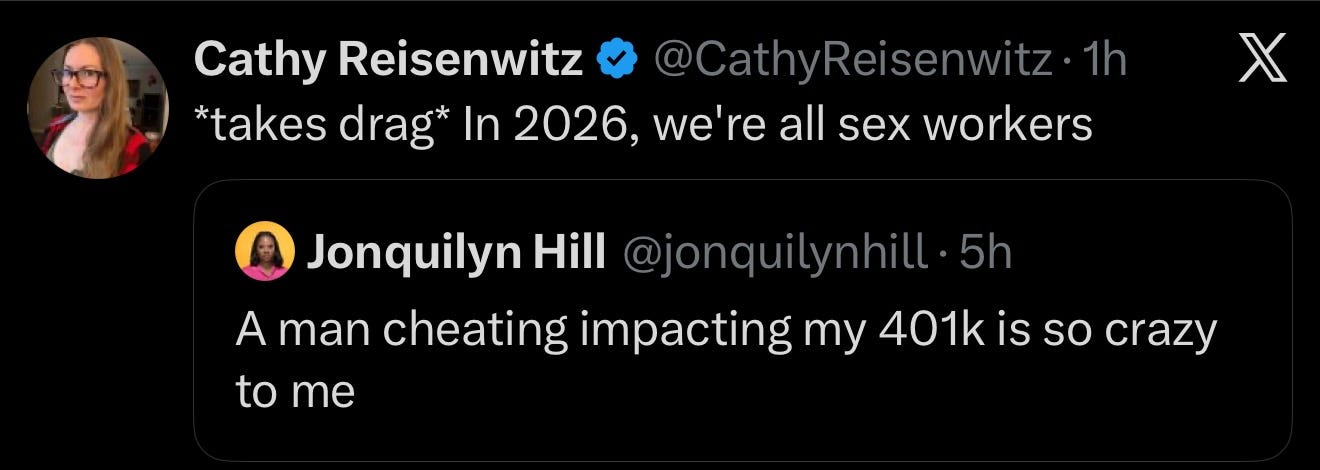
The ever-pithy libertarian Cathy Reisenwitz supplied the sharpest formulation of our shared condition: “we’re all sex workers now.”
“Mawwage. Mawwage is what bwings us togethah today” — William Goldman, The Princess Bride
When Lori and Jensen met, as when most young people meet, the scale of their future interdependencies could not have been in view. After all, there is little romance in imagining a future as a set of safeguards and hedges against everything beyond the horizon of expectations or understanding.
But the implications of a union are in the living. Children, companies, homes, friendships, fortunes—they emerge through the projects people undertake, the lives they make possible, and the circumstances those undertakings bring into being. People acquire capacities together. They become responsible for things that did not exist when they began. What seems possible at one stage depends on what has happened along the way.
A few years ago, I began teaching a course on marriage. I was fascinated by the remarkable ordinariness of this institution. It is so powerful that it can and does mediate among individuals, families, polities, gods, economies, and sometimes even human hearts. Yet discussions of marriage tend to land in the tabloids and society pages, where they are treated as unserious or irrelevant intellectual concerns.
In our lifetimes, we imagine it, witness it, pursue it, and find ourselves shaped by the marriages of others. Yet speaking of it openly risks exposing matters too private to bear public scrutiny or inviting judgments too moralizing to illuminate the inner mysteries of a union.
All the while, marriage organizes extraordinary movements of money, labor, property, and authority. The wedding industry generates billions in annual revenue. Households accumulate assets and debts. Divorces produce settlements, and children occasion intergenerational wealth transfers. Marriage joins people whose institutional commitments cross organizational boundaries. Universities can spend years puzzling over whether a partner hire compromises merit or governance, a difficulty that tells us how much a marriage can organize.
Plenty of voices in the chattering cosmopolitan chorus were quick to diagnose this whole affair as a case of American corporate puritanism. They offered knowing shrugs and declared, “C’est banal.” Others suggested that a more liberal arrangement, a certain understanding, even a declaration of openness or non-monogamy, might have saved the corporation and its shareholders quite a lot of trouble. Others welcomed the opportunity to ask what private conduct might tell us about the capacity to conduct public affairs. They wondered whether someone who betrayed a lifelong partner could be trusted with the fortunes of everyone else.
What Constitutes a Union?
This particular case is spectacular, no doubt. NVIDIA is a global company with 42,000 employees, tens of millions of retail investors, and a complex web of supply chains, financing arrangements, and production and distribution systems. At its core are strong personal relationships connecting the company to suppliers and political leaders. It takes decades to build this kind of ecology.
From the perspective of American Collectivity, marriage is fascinating because it clearly concerns more than any two private individuals. Marriage sits within an enormous architecture of commitments. Its disturbances travel along connections its participants scarcely knew were there, sometimes across the world.
Marriage gives some form to open futures. It mediates those futures through blessings, dowries, investments, and debts. It is a practice through which institutions gain some purchase on one another. Indeed, one could spend a lifetime discussing these arrangements without ever speaking of love. This is the terrain of the oikos, the domestic political economy, and all the relations it brings.
Perhaps we avoid such accounts precisely because understanding every implication in advance would require seeing the whole thing from the end already. What would become of any promise made under such conditions? Could anyone felicitously make it?
But this, I think, is why we must speak about the balance sheets and interdependencies of marriage. Its forms carry an accumulated human record of filial requirements, wealth transfers, mergers, acquisitions, and dissolutions. These arrangements remain even when love decides it has no further patience for the offices at hand.
A union can end while much of what it brought into being continues. Children have futures. Debts come due. Projects acquire participants, and other people build lives around them. The conditions once so felicitous for belonging can change without releasing everyone from what has accumulated. This is no less true of corporations, organizations, or states: each binds people to futures that they cannot fully know, generating conditions of interdependence in advance.
Something of a company’s merits becomes apparent in what can keep going when the founders move on. Those who have invested work, ambition, and even love carry the endeavor forward through purposes of their own.
Even a crisis cannot reveal the whole. A union begins with an “and”, but the implications are in the living.
When the chips are down, we discover something of what a union has come to have and to hold.
Discussion about this post